
 Listen

Winding rivers and scenic canyons make the Hill Country beautiful. But its beauty also makes it susceptible to flooding, so much so that it’s earned the nickname “Flash Flood Alley”. In this episode we dive into what makes the area so vulnerable and look into its history of flooding — and how residents and visitors alike have been warned of massive floods before. We also follow Matthew and Wendie Childress as they process earth-shattering news about their daughter, Chloe, a counselor at Camp Mystic.
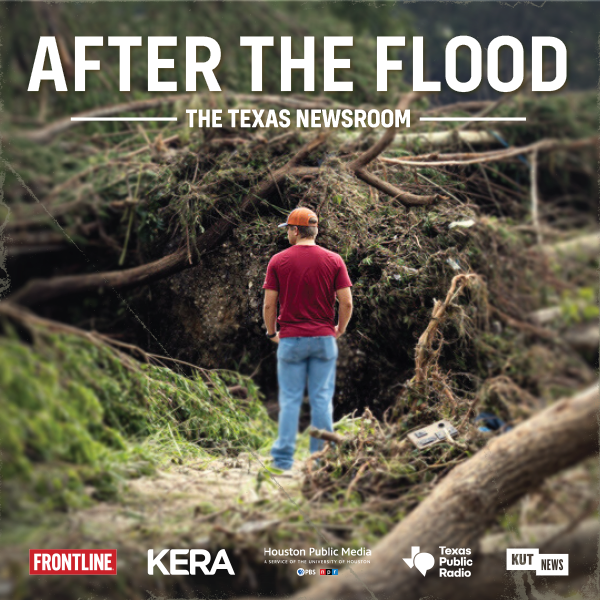
After the Flood is a collaboration of The Texas Newsroom and PBS’s Frontline.
The full transcript of this episode of After the Flood is available on the KUT & KUTX Studio website. The transcript is also available as subtitles or captions on some podcast apps.
Dominic Anthony Walsh: Previously on After the Flood.
Joe Hererra: I looked at my rain gauge. It was seven and a half inches, and that’s 45 minutes. That’s a lot of rain. Something’s going on here.
911 call: Do you need police, fire, or EMS? I need everything, sir. My house is so flooded.
We’re working on getting those that are affected by the flood rescued.
Right now- Okay … the best thing that you can do is get as high of ground you, possible, on top of the roof of the house, vehicle, attic.
Jake Richards: The screaming for people who are losing their stuff turned into screaming for people who are fighting for their lives. Then it just stops, and that’s the most haunting sound in the world, is that silence.
Matthew Childress: We were the final people to be called, was we were the counselor’s parents, to let us know that Chloe was unaccounted for.
Press Conference: I want to tell y’all that we will be working around the clock 24/7 till every person is found. Uh, what I can confirm at this point are about 24 fatalities.
We’re not gonna be giving any-
Matthew Childress: And it really struck me hard, the horror and terror that may be laying ahead for us, that I may never see her again
Dominic Anthony Walsh: Camp Mystic lies in a vulnerable position along the Guadalupe River. It’s right on the banks where the river meets a creek. Usually, this location only adds to Mystic’s appeal. Campers take to the water to kayak and canoe. Activities also include archery, horseback riding, and basketball. It’s a special place.
That’s why so many girls, including Chloe Childress, came to Camp Mystic every summer. Their desire to get offline and into nature always struck Chloe’s father, Matthew.
Matthew Childress: You would think in this day and age, um, a teenager wanting to go someplace where they can’t have their mobile phones, they might resist.
But this was something that she looked forward to the most every single summer. Even when she was not a camper any longer, she wanted to go back to be a counselor so she could continue to embrace and appreciate this place.
Dominic Anthony Walsh: And she wasn’t the only Childress to spend time at Camp Mystic. Chloe’s aunt and even her grandmother attended, too.
There’s a history there, a personal one spanning decades, alongside Mystic’s own century-old legacy.
Matthew Childress: This is somewhere that has been around for 99 years. It has majesty. It’s beautiful. You’re disconnected from the real world. You’re able to go to this place and have such a good time, fun, connecting with friends, and making new friends across the state and beyond.
Dominic Anthony Walsh: But Matthew says it was more than that. Returning each summer provided his daughter with spiritual nourishment, too.
Matthew Childress: One thing Chloe loved about going to Camp Mystic is that it did come with that component of the Christian faith.
Dominic Anthony Walsh: Campers spent the day with prayer and Bible study in between activities like archery and canoeing.
Matthew Childress: And it gave her reassurances. It gave her direction.
Dominic Anthony Walsh: Matthew says he always admired Chloe’s independence, a self-determination and faith that grew stronger each year.
Matthew Childress: I love that she would read scripture, and it wasn’t something she was gonna come down and preach to me about. It was something she believed in, which I respect her for that.
Going back to, to camp each year, which she spent 10 years going as a camper, something that she looked forward to the most every single summer.
Dominic Anthony Walsh: Camp Mystic has programs for girls ages seven through high school. Chloe loved it so much she wanted to keep coming even after she had been a camper. For the 2025 season, Chloe decided to return as a counselor.
She’d be working and bunking with some of Camp Mystic’s youngest kids. She was so excited that she left Houston for the Hill Country a day earlier than Matthew had expected.
Matthew Childress: Usually I’m the sentimental one in the family that has troubles saying goodbye with drop-offs at camp and such. So I had to quickly say goodbye to my daughter for a month.
Dominic Anthony Walsh: That was June 27th.
Matthew Childress: It was sweet. It was fine. She gave me a big hug and kiss. I told her 17 kisses, which is our way of saying goodbye and good night to one another for her entire life. And then she said, “Don’t worry about it, Dad. I’ll see you soon.”
Dominic Anthony Walsh: Eight days later, on July 5th, Matthew watched the sunrise after an agonizing sleepless night in Kerr County. With his wife, Wendy, he waited and waited for an update on their daughter.
Press Conference: Uh, good morning to everybody. We appreciate you being here. Appreciate your, uh, uh, coming out here and covering us in this difficult time.
Matthew Childress: All through the day, from about 8:00 AM to 6:00 PM, in between press conferences where we were begging for information from the authorities, any type of information, deaths, rescues, but no data coming our way, um, constantly across the room, you could hear people sobbing, and many times that was me sobbing.
Press Conference: Here’s some new updated numbers for y’all.
Matthew Childress: In the 6 o’clock hour is when we started to receive phone calls, and this is following the last press conference where the county authorities and city authorities told us that they had not rescued anyone alive.
Press Conference: As of 5:30, we have recovered 43 deceased individuals in Kerr County.
Among these who are deceased, we have 28 adults and 15 children.
Dominic Anthony Walsh: And still, it almost didn’t seem real.
Press Conference: 12 adults pending identification and five children are pending identification at this time.
Dominic Anthony Walsh: This couldn’t be real, not here in this stunning part of Texas, not at the camp where Chloe and generations of women in her family had made so many idyllic childhood memories.
The difference between that heaven and the hell that Matthew and Wendy now found themselves in was immense, and it points to something we’ll spend much of this episode exploring. Because the same things that make Kerr County beautiful, the winding rivers, the rolling hills, the steep limestone cliffs, those attributes also make the area extremely vulnerable.
So vulnerable, in fact, that it’s earned the nickname Flash Flood Alley.
Kim Tomes: When it rains really hard, even after all these years, I’m looking for a hill
Dominic Anthony Walsh: This is After the Flood, a podcast from the Texas Newsroom and PBS’s Frontline. Starting on July 4th, 2025, the Texas Hill Country saw one of the deadliest floods in US history. More than 130 people died, many of them children. The destruction prompted a lot of questions. Mainly, how could a massive flood like this catch so many people off guard, from residents to emergency officials, to leaders at the numerous summer camps lining the river?
What went wrong, and were these deaths preventable? I’m Dominic Anthony Walsh. This is episode two, A Place Where Memories Are Made.
It’s no secret that this part of the Texas Hill Country is prone to flooding. It’s happened before, and the people in power in Kerr County, the state, and even members of the Eastland family, which owns and operates Camp Mystic, were committed to doing something about it decades ago. But that resolve faded over time and became, in some ways, complacency.
And I should note, there are some difficult stories ahead, including descriptions of traumatic moments, loss, grief, and death. So please take care while listening In my humble opinion, the Texas Hill Country is the most beautiful place in the state. I’m gonna try to describe it with a little help.
Kim Tomes: It’s as if some supreme landscaper pieced together cypress-lined streams, sunsets, and scenic canyons.
This is what they call the Texas Hill Country. Hello, I’m Kim Tomes. Let me
Dominic Anthony Walsh: be one of the first people- This is a promotional video from 1988 made by the Kerrville Convention and Visitors Bureau. The title sums it up well, Outdoor Heaven in the Hill Country. It came out almost 40 years ago, some time before I was even born, but it holds up.
The beauty of the Hill Country feels timeless.
Kim Tomes: Natural beauty sprawled over hundreds of square miles, tied together with a clear winding ribbon called the Guadalupe River.
Dominic Anthony Walsh: I think this video paints a pretty accurate picture of how most Texans from outside the region have long viewed it, a tried and true and safe vacation destination.
I’m from San Antonio, which is often referred to as the gateway to the Hill Country, and growing up, I actually spent time on the Guadalupe River in Kerr County almost every summer.
Kim Tomes: Here are located some of the finest summer camps in America.
Dominic Anthony Walsh: During the hot afternoons at camp, we swam in the slow but strong current and swung off ropes from the steep banks.
At night, we jumped off highway overpasses into the dark water, even though we definitely were not supposed to. For a kid, it was close to heaven. I remember the adrenaline spikes as I hurdled through a ropes course with dozens of other Cub Scouts at Bear Creek Scout Reservation. And then when I got older, orchestra camps at MO Ranch- Art camps, drama, and theater- Where we split our days between rehearsals and splashing in the river
Kim Tomes: as summer’s reveille turns to autumn’s taps, those who have left will be those who will return.
Dominic Anthony Walsh: And I did, at least six summers in a row. Like countless other Texas kids and families, all eager to revisit the Hill Country’s limestone hills and cliffs, towering bald cypress trees, and its rivers and creeks.
But there’s a flip side to that beauty.
Louis Amestoy: The topography makes this an area just prone for massive flash floods, and that’s where they kind of talk about flash flood alley.
Dominic Anthony Walsh: This is Louis Amestoy. He runs a local publication called The Kerr County Lead. He covers Kerrville and surrounding communities, and quite often, that means weather.
Louis Amestoy: We’re having, like, regular extreme weather events every year. I’ve been here six years. We’ve had one every year. You know, in 2021, we had the awful winter storm. We had another winter storm in 2022. We had a extreme heat wave in 2023.
Dominic Anthony Walsh: Those extremes are worsening with climate change. Dry spells are getting drier, wet spells wetter.
Louis Amestoy: 2024, we had another flood.
Dominic Anthony Walsh: And the frequency of severe weather is increasing, too. Louis hosts a daily podcast. In 2024, about a year before the flood, he had a meteorologist on the show
Louis Amestoy: We were talking, I think it was Beryl or one of those hurricanes, and people were advocating because the drought was so bad here, you know, “Hey, wouldn’t it be great if the hurricane would just end our drought for us?”
But he’s like, “No, no, that’s the worst possible idea because we can’t handle that large amount of water. This is Flash Flood Alley. You know, we don’t want a storm to sit and dump on us. That would be a catastrophe.” And he was right.
Dominic Anthony Walsh: So let’s talk a bit about where the name Flash Flood Alley came from.
There’s a massive geologic fault line, essentially a big cliff that formed at least 20 million years ago that borders the Hill Country, and that cliff serves as a meeting place for moist air from the Gulf Coast to crash into dry air from the west, causing some of the highest rainfall totals in the world.
Once that rain hits the ground, it moves at an astonishing speed through the Hill Country’s terrain.
Louis Amestoy: When you look at the natural topography of this region, it’s also pushing water down all these little, little canyons and little, these little channels that come off the hills.
Dominic Anthony Walsh: These canyons and hills are not grassy or marshy.
They’re limestone, so the rainwater doesn’t soak into the ground. It rushes down steep valleys, swelling the Hill Country’s iconic rivers, and it can be incredibly destructive if you have too much rain fall all at once, like July 2025.
Louis Amestoy: We can’t handle that, a large amount of water. We need, like, you know, an inch of rain here, inch of rain here.
We can’t, we can’t have it all at once.
Dominic Anthony Walsh: Because if it does come all at once-
Kim Tomes: It’s gonna come get you.
Dominic Anthony Walsh: That is none other than Kim Tomes.
Kim Tomes: Hello, I’m Kim Tomes. Let me be one of the first to welcome you to the heart of the beautiful Texas Hill Country.
Dominic Anthony Walsh: I recently tracked Kim down. She lives in San Antonio, and is still drawn to the beauty of the area.
But turns out she has a story of her own about the flip side of the beauty. It was 1978. Kim was 22 years old and vacationing with her family on the banks of the Medina River, another iconic Hill Country river south of the Guadalupe.
Kim Tomes: I was in a little cabin with my mom and my little sister. I’d say there was probably about, I don’t know, 12 to 15 cabins out there.
Dominic Anthony Walsh: She had won the Miss USA beauty pageant the year before and was ready for a break.
Kim Tomes: And I thought, “How nice to go out there, have peace and quiet, lay by the f- pool, not have anybody come up wanting autographs.” I mean, I was ready to relax, read books. And so, um, it started raining, and some people left because it just kept raining and raining.
Dominic Anthony Walsh: She’d seen rain before on these vacations, even flooding, but not like this.
Kim Tomes: I woke up about 3:00 in the morning, and I heard this gurgling noise, and I thought that the toilet had overflowed or something. I thought, “That’s weird.” So I swung my leg out to get out of bed And I was hit by the iciest, coldest water ever.
So I look back behind me, and I had a window open, and there was like a waterfall coming into the cabin.
Dominic Anthony Walsh: Tropical Storm Amelia was underway, and it would wreak havoc across Texas. Nowhere more than in the Hill Country, though, where at least 27 people died. And Kim barely survived. She got her family out of the cabin by cutting a hole in a window screen with a knife.
They waded through waist-deep, rushing water.
Kim Tomes: You could hear people waking up and screaming and yelling, and it was trees are starting to rip up and houses are starting to rip up. Fences are going by, cows are going by, uh, roofs are going by. And the other thing is it was so loud, like, like an aircraft carrier or a train.
It was that rushing water was so loud, it was deafening. A tree hit me from behind, and it shot me down under the water. So then, this part is this really scary part, is because when I got pushed underwater, it was silent. It was so quiet and black, and I didn’t know which way was up. I didn’t know which way was sideways or down.
I’m just spinning under the water. I felt like I’m gonna die, but I was, it was, it’s hard to explain, but it was like you were at peace because it was very soft water, very quiet, very black, and it was just a really, a peaceful time for me. I was spinning, spinning under the water, and then all of a sudden, somehow I popped up and just was like, you know, gasping for air.
And I saw a tree over kind of to the side to me, and that was the last tree. And I went, I swam. I mean, I was like super human strength. I was a swimmer, but I mean, it was really difficult to get to this tree. But I got there
Dominic Anthony Walsh: She perched on that tree for hours, waiting for the water to recede
A TV crew from San Antonio captured the rescue effort over the next day. The cameraman even got a shot of Kim stepping off a helicopter in the small town of Bandera. She made the news. There’s a picture of her in a newspaper from the time labeling her-
Kim Tomes: Miss USA Flood Heroine.
Dominic Anthony Walsh: Kim keeps going back to the Hill Country.
It still calls to her, but last year’s news brought back some tough memories.
Kim Tomes: I mean, it, when it rains really hard, even after all these years, I’m looking for a hill. I mean, I really, it, it, the news of all this really got to me.
Dominic Anthony Walsh: The 1978 flood was described at the time as unprecedented, catastrophic, record-breaking, but less than a decade later, it happened again.
Reporter: On Friday morning, July 17th, 1987, the small town of Comfort, Texas, became the scene of a heroic rescue and tragic loss.
Flood survivor: That day probably was one of the, the most traumatic of my whole life.
Speaker 14: We thought the only people that were alive were the ones that were around us, and we were scared to death. I know I’ll never get over this, ’cause it’s something that’s gonna be on my mind forever.
Dominic Anthony Walsh: Listening to the news coverage of this one really gives me an eerie sense of deja vu to the flood from last summer.
Speaker 15: Good evening. It’s well known in the Texas Hill Country that flash flooding can be extremely dangerous.
Dominic Anthony Walsh: It was mid-July, 1987. The flood hit in the early morning hours, causing the Guadalupe River to rise an astonishing 29 feet, and-
Speaker 15: The victims were summer
Speaker 16: campers.
Dominic Anthony Walsh: They were trying to- The victims that year were from a summer camp, just about an hour’s drive from Camp Mystic.
Speaker 17: The teenagers were being evacuated from Camp Pot of Gold, a Baptist church camp, during a driving rainstorm.
Speaker 16: They were trying to drive over a low water crossing when one of two vehicles stalled.
The vehicle started filling with water, so they held hands and tried to wade out, but the strong current swept some of them away.
Dominic Anthony Walsh: 43 people were carried into the waters. Most of them were rescued.
Reporter: But 10 children died in the waters of the Guadalupe River.
The river has returned to normal, but the lives it touched remain forever changed
Flood survivor: Sometimes we’ll cry about it, and sometimes we wish we were dead sometimes and that
they were still here All four of my kids were there, and so we lost two, and we got two back, so we know what both ways feels like, getting your kids back, plus losing your kids.
There’s a empty spot in my life, a big one
Dominic Anthony Walsh: After the 1987 flood came a reckoning, much like the one we’re seeing today. Tough questions, promises of change, lawsuits. Back then, there was only one way to warn people along the Guadalupe that the water was coming for them. Whenever it rained a lot, folks who lived upstream would watch the water rise and call folks downstream to let them know.
That was it, a good old-fashioned phone tree. But after the 1987 flood, local leaders decided that enough was enough. It was time to stop relying on a literal game of telephone and instead install an actual flood warning system, gauges that would measure rainfall and river levels in real time and transmit those readings to emergency managers.
Kerr County residents grumbled about the cost, which they had to cover through higher property taxes. But Kerr County area officials insisted. The system came online in 1989. Yet last summer, when asked how such a catastrophic flood could catch so many people off guard, their answer was
Rob Kelly: We do not have a warning system on the river.
Dominic Anthony Walsh: So what happened? That’s coming up after the break
This is After the Flood. I’m Dominic Anthony Walsh. In 1989, just a few years after 10 Hill Country summer campers died in a flood, Kerr County officially brought its then state-of-the-art flood early warning system online. One of the system’s biggest champions was Dick Eastland, owner of Camp Mystic. At the time, he told a reporter, “If it saves one life down the road, it will be worth it.”
On July 4th, 2025, Dick Eastland and a group of young campers were attempting to evacuate when their SUV was swept away and hit a tree. Data from Eastland’s car and Apple Watch shows that they sank into the river and likely died around 3:51 AM A few hours later
Rob Kelly: Good morning. Um, I wanna thank everyone for, uh, being here and, um, uh, being part of this, uh, response.
Dominic Anthony Walsh: Judge Rob Kelly, the top elected official in Kerr County, stood in front of reporters to make his first statements on the tragedy
Rob Kelly: Suffice it to say, this has been a very devastating and deadly flood.
Dominic Anthony Walsh: The questions came pouring in. Mostly, how could flooding like this happen seemingly with no warning?
Reporter: Can you talk to us about what kind of warning system might have been in place last night, just to make sure that everybody got out safely?
Rob Kelly: We do not have a warning system on the river. “
Dominic Anthony Walsh: We do not have a warning system,” Kelly said. That warning system that had been installed in 1989, it was long gone by now, according to a Houston Chronicle investigation. The private company that was operating the system shut down in the late 1990s, and the equipment fell into disrepair.
Every few years, local officials talked about bringing it back, but they never did. They weren’t willing to spend the money. Reporters at that press conference with Rob Kelly pointed out that even without a warning system, there was the weather forecast in advance of July 4th. State emergency officials had been preparing for major flooding.
They sent emails about it to local emergency managers across Texas, including in Kerr County.
Reporter: Judge, Texas Department of Emergency Management put out an all call and said, “There’s gonna be a problem.” There are kids missing. These camps were in harm’s way. We knew this flood was coming.
Rob Kelly: We didn’t know this flood was coming.
Rest assured, no one knew this kind of flood was coming. We have floods all the time. This is the most dangerous river valley in the United States.
Reporter: I-
Rob Kelly: And we, and we deal with floods on a regular basis. When it rains, we get water. We had no reason to believe that this was gonna be any, anything like what’s happened here.
None whatsoever.
Dominic Anthony Walsh: You can actually hear alerts going off on people’s phones as Kelly is speaking. Some of those were flash flood warnings, and several had gone out hours earlier, while most people, including many local officials, were asleep. Like one alert from the National Weather Service at 1:14 AM, warning about life-threatening flash flooding in central Kerr County.
And there was the rising water, which started waking residents as early as 3:00 AM. There’s this call from a hotel manager 20 miles upstream from Kerrville at 2:53 AM.
911 caller: And the water’s coming up really high, really quick. Uh, it’s A big flood coming
Dominic Anthony Walsh: At 3:36 AM, they got this call. It came from 17 miles upstream from Kerrville.
911 caller: We’ve never had water this high. Okay, so it’s- There’s, there’s no place for us to go.
Dominic Anthony Walsh: And this call at 3:39.
911 caller: Kerr County 911.
Dominic Anthony Walsh: But the dispatcher could only hear water in the background.
911 caller: Kerr County 911. Kerr
County Sheriff’s Office. Hey, it’s an open line. I can just hear what sounds like water.
Dominic Anthony Walsh: A few minutes later, 14 miles from Kerrville-
911 caller: We’ve got lots of people in cabins. We don’t know how to get out. We don’t know what to do
Dominic Anthony Walsh: While all this was happening, most of the top leaders in Kerr County and Kerrville later admitted in testimony to state lawmakers that they were still in bed asleep.
Kerrville City Manager, Dalton Rice, was awake in the early morning hours of July 4th. In a story that he would repeat over and over again to reporters in the following days, he explained that he didn’t see anything amiss.
Dalton Rice: I was running the river trail at 3:00 AM this morning just ’cause I’m that guy, and there was no signs of it.
The rain was here, um, on the river trail, which is down below at the water’s edge. At 3:30 and 4 o’clock when I left, there was no signs of it rising at that point.
Dominic Anthony Walsh: In other words, even if other officials had been awake looking at this part of the river, Rice says they wouldn’t have seen anything either. We should note that the city of Kerrville never made Rice or other city officials available for us to interview.
Dalton Rice: This happened very quickly over a very short amount of time that could not be predicted, um, even with the radar.
Dominic Anthony Walsh: But the river was rising. It was just rising upstream from where Rice was jogging, far outside of Kerrville’s city limits, including at Camp Mystic, where the first 911 call that we know of came in at 3:56 AM.
911 caller: But we are all getting out of all the cabins, but some of the cabins are filling up with water.
Dominic Anthony Walsh: At 4:19 AM, a neighbor downstream of the camp called.
911 caller: The flood is up to our house right now. We’re okay, but we live about a mile down the road from Camp Mystic, and we’ve already got two little girls who have come down the river, and we’ve gotten to them, but I’m not sure how many else are out there
Dominic Anthony Walsh: By this point, Judge Kelly, the Kerr County Sheriff, and their emergency management director were still not aware of the disaster that had already unfolded at Camp Mystic. My colleagues at the Texas Newsroom and the Texas Tribune got ahold of communications among Kerr County officials on July 4th. The earliest text message they found referring to Mystic was sent at 6:34 AM, more than two and a half hours after the first 911 call from the camp.
It was a text from a Kerr County Sheriff’s captain, “Dispatch is trying to verify Camp Mystic and Camp La Junta issues.” An hour later, he texted the security guard at Camp Mystic. “
Emily Foxhall: Please confirm 30 campers missing and unaccounted for.”
Dominic Anthony Walsh: This is Emily Foxhall, a reporter for the Texas Tribune.
Emily Foxhall: You can see officials in these text messages just grappling with understanding what happened, trying to figure out who was missing, trying to figure out how many were dead.
Dominic Anthony Walsh: According to the Texas Newsroom and the Tribune’s reporting, it would be hours before the Kerr County Sheriff’s Office understood what had happened that morning. The county never responded to our request for comment for this show.
Emily Foxhall: You can see in these text messages that county officials really spend all day trying to figure out what happened at Camp Mystic, which, you know, is just kind of illustrative of the chaos of a disaster of this scale.
Dominic Anthony Walsh: For instance, at 9:45 AM, a sheriff’s captain writes that everyone at Camp Mystic is accounted for, but then some 20 minutes later, he says the information may not be reliable. Almost 10 hours later, Kerr County Sheriff Larry Leitha sent this message. “
Emily Foxhall: I was told there may be several children that the game wardens pulled out dead.
The lieutenant governor is asking. I need this verified and reported back
Dominic Anthony Walsh: ASAP.” And about 15 minutes later, another text from an unidentified number, “We need to get a statement out to the parents at the reunification site. They are getting very upset that they have not been given any information.” One of those parents was Matthew Childress.
On the evening of July 4th and much of July 5th, he sat with other Mystic parents, waiting, watching many of them reunite with their children. And on Saturday, July 5th, around 6:00 PM-
Matthew Childress: We were all kind of standing in a group, and I felt my phone vibrate in my pocket, and I pulled it out, and I showed everyone that was sitting in front of me that it was a Kerrville number.
So I went ahead and answered it. I turned away from them and said hello. I remember it was a gentleman, who I believe was a sheriff’s officer. I don’t remember specifically what he said, but all I remember him saying was Grimes Mortuary And I collapsed, dropped my phone, and started to wail. And all I remember is my wife telling me to grab my phone and my brother and sister who were there kind of helped to pick me up and kind of carry me out of there to get us in the car to go to the mortuary.
You know, even in those moments, we were still hoping that perhaps it was a misidentification, that it was possibly someone else. And I had to make the decision to identify her. And somehow I was lucid enough to be able to understand of if I somehow didn’t do it myself that I would regret it. And so my wife and I went in, identified her.
It was absolutely terrible. I wish that upon no man or woman seeing my firstborn, my hero, being in that state. But I’m glad that I did it. I’m glad my wife and I had the courage to identify her. And my poor brother and sister had to sit there and listen to us suffer as we reacted to that, which I will always forever thank them for their support to pull us through that terrible moment.
But at the same time, as I had said goodbye to her a week earlier and gave her 17 kisses, I went back in and gave her 17 kisses before we said goodbye. That’s how we said goodbye, good night every night.
Dominic Anthony Walsh: Matthew and Wendy made the long drive back to Houston.
Matthew Childress: So when we got home, it was tough to get back to her room.
It was tough to come into the house. It took me probably 15 minutes to get out of the car because I was so terrified to come into the house. Once we got to see my son and my in-laws, I told my wife we need to go upstairs and be in Chloe’s room. Otherwise, I would be afraid of going in there, and I needed to go in there immediately.
So after a long sobbing on her bed, and we started to kind of wander around, and I believe maybe an hour or so later, we were still just kind of wandering around, going through her things. And my wife had seen in her bathroom the sticker that said Isaiah 43.2 on it. That’s not something I’m familiar with, and we had to look it up what it was.
Dominic Anthony Walsh: Isaiah chapter 43 verse 2. When you pass through the waters, I will be with you, and through the rivers they will not overwhelm you.
Next time on After the Flood, we’ll hear how Matthew Childress and other parents have turned their grief into action.
Matthew Childress: It’s really about, again, uncovering the true timeline, the true actions that were taken.
Dominic Anthony Walsh: What were camp managers and county officials doing as the disaster unfolded, and how did state lawmakers respond?
Senator Ann Johnson: The three guys in Kerr County who were responsible for sounding the alarm were effectively unavailable.
Dominic Anthony Walsh:
After the Flood is a production of the Texas Newsroom and PBS’s Frontline.
This episode was written by me, Neena Satija, Lucio Vasquez, and Sarah Grunau. Our editors were Neena Satija and Rachel Osier Lindley. Ana Campbell is our executive producer, and Elizabeth McQueen is our producer. Our editors at FRONTLINE are Erin Texeira and Mia Zuckerkandel . Our music is by Rene Chavez and APM and our audio producers are Casey Cheek, Jake Perlman and Matt Largey. Our multimedia editor is Deborah Cannon and Michael Minasi is our multimedia producer. Our fact-checker is Ena Alvarado, and our attorney is Thomas Leatherbury. Erin Geisler oversees our marketing, and our cover was designed by Maile Carballo. Corrie MacLaggan is the executive editor of The Texas Newsroom. Special thanks to Lauren McGaughy. The Texas Newsroom is a collaboration among NPR and the public radio stations in the state, including Houston Public Media, KUT in Austin, Texas Public Radio in San Antonio and KERA in North Texas. This project received editorial and financial support from FRONTLINE’s Local Journalism Initiative, which is funded by the John S. and James L. Knight Foundation.
This transcript was transcribed by AI, and lightly edited by a human. Accuracy may vary. This text may be revised in the future.